


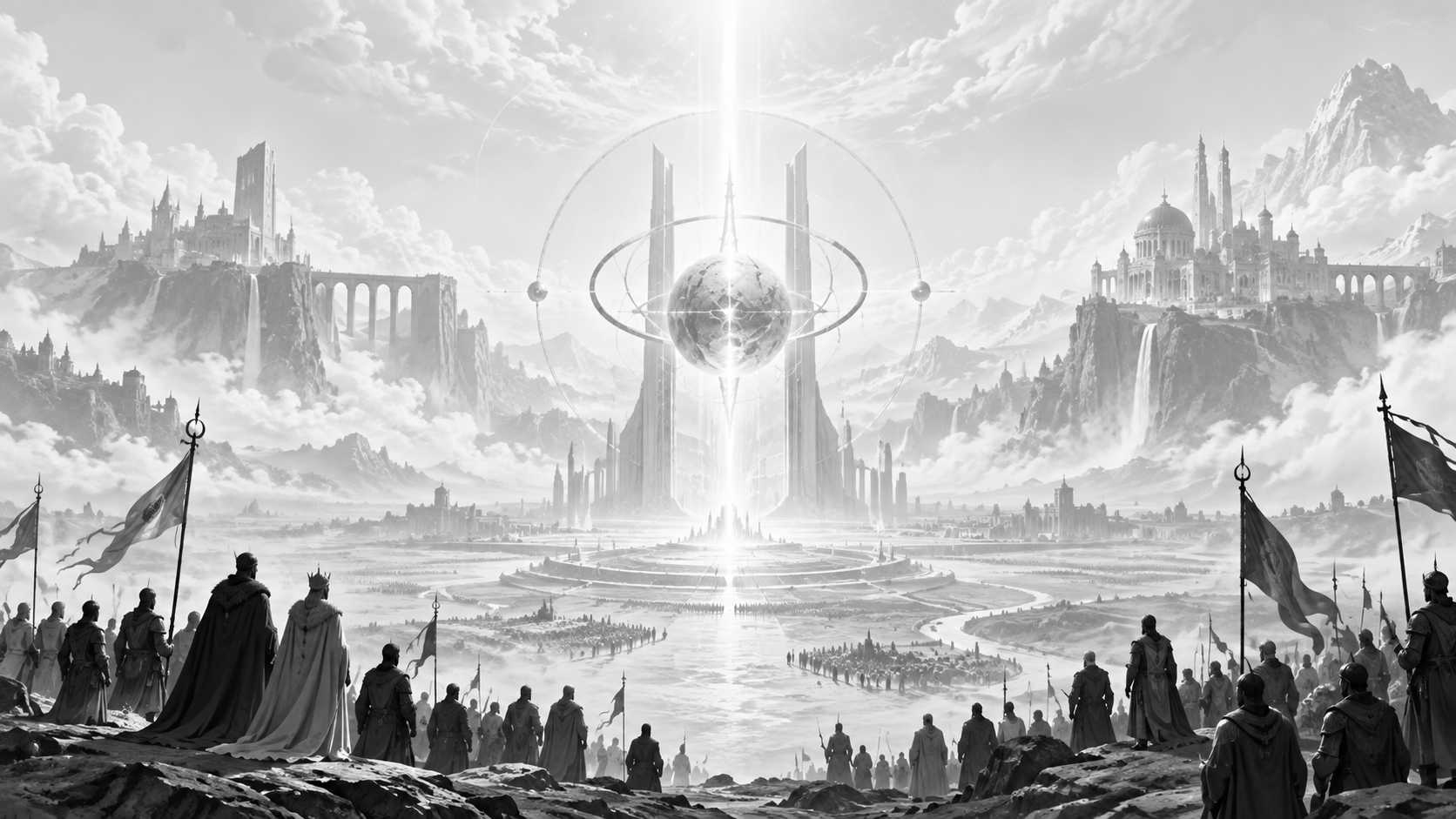
This book is a mythology about technology.
Not because technology needs mysticism, but because engineering visions become more durable when the principles beneath them can be remembered as a coherent story.
Qorpra and Qorpix were conceived around a simple frustration: modern computing is extraordinarily powerful, yet human intention is forced to fracture as it crosses technical boundaries. A single idea may pass through interfaces, backend systems, serialization, networks, runtimes, operating systems, devices, machine instructions and silicon—often changing languages, tools, models and mental frameworks at every step.
The cost of that fragmentation is not only technical. It is cognitive, organizational, economic and human.
Why a Myth?
Architecture explains what a system is.
Documentation explains how to use it.
A roadmap explains where it may go.
But none of those necessarily explains why the world should exist at all.
The Qorpra Myth exists to hold that why.
The kingdoms are technical silos.
The light is continuity of human intent.
The battlefield is the cost of fragmentation.
The living tree is extensibility.
The answering light is intelligence.
The descent into matter is the compiler, runtime, operating system, device and machine continuum.
The civilization of creators is the social consequence we hope such continuity can enable.
One Language, Not One Thought
Qorpix aims toward one language across many computational layers.
That ambition must never be confused with forcing every layer to behave identically.
Unity is not sameness.
A graphics domain, an operating system kernel, a distributed service, a scientific model and an intelligent agent may need different semantics. The goal is not to erase those differences. The goal is to let them belong to one coherent language and ecosystem rather than demanding a new technological universe for each.
Different layers deserve different semantics—not different universes.
The Grayscale Edition
This edition uses only white, gray and black as its visual language.
That choice is deliberate.
A philosophy that seeks one language across many layers should not depend on decorative complexity to express identity. Grayscale emphasizes form, structure, hierarchy and contrast. It allows the architecture to speak before the ornament does.
It also mirrors the central Qorpra idea: diversity of function does not require fragmentation of identity.
The Six Phases
The main saga unfolds in six phases.
Phase I ends the War of the Layers and introduces Computational Unity.
Phase II restores the human being to the center and establishes Human Priority.
Phase III teaches the ecosystem to evolve through first-class extensibility, trust and developer continuity.
Phase IV gives intelligence a place in the system without giving intelligence the throne.
Phase V carries intention through software into devices, machine instructions and matter.
Phase VI asks what happens when that capability is returned to civilization itself.
The epilogue then removes the mythology from the sky and places its final responsibility where it belongs: in human hands.
A Story and an Obligation
This mythology should not be read as a claim that all trade-offs can disappear.
Some boundaries are physical.
Some are economic.
Some are safety constraints.
Some differences are genuinely fundamental.
Qorpra begins by demanding that such limits be demonstrated rather than inherited unquestioned.
Whenever a boundary exists, we should know why.
Whenever complexity is exposed to a creator, we should know why the system could not absorb it.
Whenever a machine is given agency, we should know who remains accountable.
Whenever an ecosystem creates value, we should know whether the people expanding it can participate in that value.
The mythology therefore carries an obligation.
Technology should expand human capability without making humanity subordinate to the machinery that expands it.
Begin
The first story begins where many technological stories begin.
With experts who became kingdoms.
With boundaries that became identities.
With tools that stopped understanding one another.
And with a question:
What if the layers were never separate worlds?