


Every mythology eventually reaches the place where it must stop adding kingdoms, powers and victories.
It must become quiet enough to ask what the story was for.
The Qorpra myth began with a battlefield.
It ends with a pair of hands.
The Light Continues
Long after the sixth age, children still hear the story of the War of the Layers.
They hear of the architects above the clouds, the keepers of logic, the machine houses, the device clans, the cloud lords, the keepers of data and the smiths of silicon.
They hear how each kingdom became so fluent in its own truth that it forgot the existence of the whole.
They hear of the night without stars.
And of the beam that came down between armies.
The children always ask the same question.
Did the light really come from the sky?
The elders answer differently.
Some say yes.
Some say the story is only a metaphor.
Some say the light had always been there and the war merely prevented anyone from seeing it.
The Qorpra tradition does not insist on one answer.
Because the important part of the story was never where the light came from.
It was what people did after they saw one another clearly.
The Children of the Battlefield
The old battlefield became a place of learning.
Its stones were preserved, not as trophies of victory, but as evidence of fragmentation.
Visitors could still see where the armies once stood.
At the center was no statue of a conqueror.
There was an empty circle.
The circle represented a space that could never permanently belong to one layer, one company, one machine, one model, one institution or one generation.
It belonged to the whole.
And because the whole was alive, nobody could finish it.
A living system is never complete. It is only coherent enough to continue.
No Final Architecture
This became one of the final lessons of the mythology.
Qorpra was not the final architecture.
Qorpix was not the final language.
Every claim of finality would contradict the living ecosystem that made them meaningful.
The purpose was not to freeze the future into one perfect design.
The purpose was to create enough continuity that the future could change without returning to fragmentation.
New machines would appear.
New forms of intelligence would emerge.
New scientific ideas would demand new semantics.
New generations would reject assumptions their predecessors had considered obvious.
Some parts of Qorpra would be replaced.
Some would be preserved.
Some would become invisible infrastructure.
Some would become historical artifacts studied like the old bridges of the first kingdoms.
That was not failure.
That was life.
A Covenant, Not a Throne
The myth had spent six ages rejecting thrones.
First the throne of the dominant layer.
Then the throne of the machine.
Then the throne of the immutable core.
Then the throne of autonomous intelligence.
Then the throne of abstraction that refused to touch matter.
Finally, the throne of creation controlled by only a few.
What remained was not a throne.
It was a covenant.
A promise between people and the systems they build.
The system may become powerful.
But power must remain legible.
The abstraction may become high.
But it must remain permeable.
The intelligence may become capable.
But purpose must remain accountable.
The ecosystem may become vast.
But participation must remain meaningful.
The machine may reach matter.
But the human being must not disappear from the reason for reaching it.
What Qorpra Must Never Become
Every myth contains a warning.
This one is simple.
Qorpra must never become another kingdom that believes its layer is the whole world.
If it ever demands that every problem become identical, it has forgotten unity without uniformity.
If it ever locks creators into the ecosystem, it has forgotten the right to leave.
If it ever uses intelligence to erase human judgment, it has forgotten Human Priority.
If it ever makes extensibility decorative rather than first-class, it has forgotten the living ecosystem.
If it ever hides the machine so completely that people cannot understand what their systems do, it has forgotten permeable abstraction.
If it ever extracts more value from creators than it enables them to create, it has forgotten the Civilization of Creation.
If it ever turns “one language” into “one way of thinking,” it has misunderstood Qorpix.
One language should widen the universe of expression—not narrow the universe of thought.
The Final Responsibility
Technology often presents itself as destiny.
It says progress will happen because the machines can make it happen.
The Qorpra myth rejects that comfort.
Capability does not decide direction.
Speed does not decide value.
Intelligence does not decide purpose.
Scale does not decide legitimacy.
Human beings still have to choose.
What should be built?
What should remain private?
What should be shared?
What should be automated?
What should remain deliberately human?
Which efficiencies are worth their cost?
Which boundaries protect dignity rather than merely preserving old architecture?
Which new capabilities expand freedom?
Which only move power from one kingdom to another?
No compiler can answer those questions for us.
No agent should.
No platform is morally qualified by architecture alone.
The final responsibility remains where the mythology placed it in the second age.
With people.
One Core. Every Direction.
The phrase now means more than it did when the first war ended.
One core does not mean one ruler.
It means one coherent center of principles.
Every direction does not mean expansion without restraint.
It means the freedom to move into new domains without abandoning continuity.
Qorpra is the name given to that continuity.
Qorpix is the language designed to travel through it.
But the mythology belongs to neither name alone.
It belongs to the deeper proposition beneath them:
Human intention should be able to travel through technology without being fragmented by technology.
The Open Horizon
In the final scene, the old city is seen at dawn.
The central light is faint.
Not because it is dying.
Because it no longer needs to blind anyone to be visible.
Across the city, thousands of smaller lights are turning on.
In workshops.
In homes.
In laboratories.
In schools.
In factories.
Inside devices.
Across distant networks.
In places no original map of Qorpra contained.
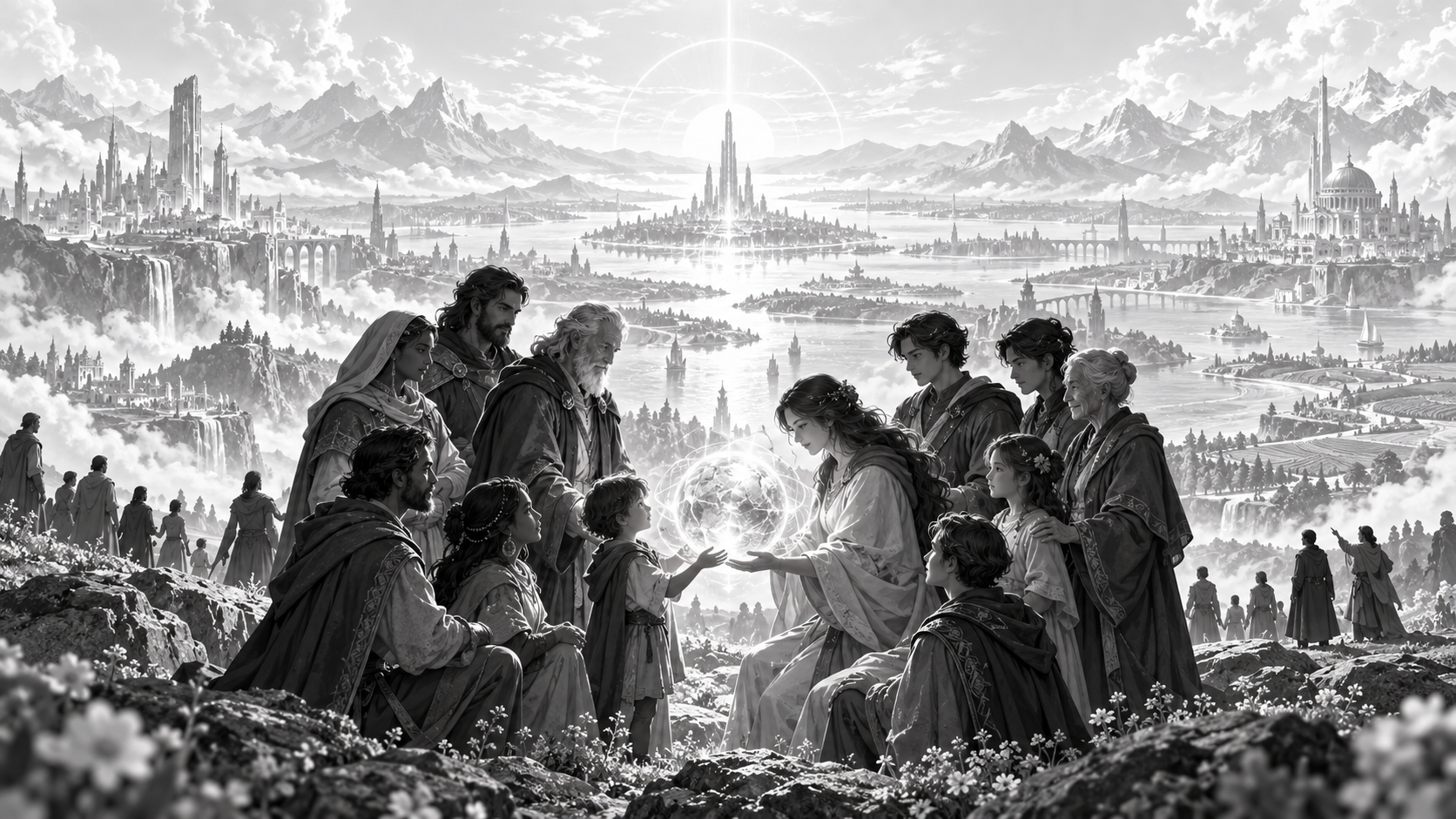
A child holds a small sphere of light between her hands.
Beside her stands an elder who remembers when such capability required a kingdom.
Neither bows to the light.
They use it.
They question it.
They shape it.
They pass it on.
Behind them, the city continues to grow.
A new branch appears on the living tree.
An agent asks for direction.
A machine wakes.
A compiler begins lowering intention into instructions.
Somewhere, silicon changes state.
Somewhere else, a person sees an idea become real.
And beyond the city is an open horizon.
No final kingdom.
No final machine.
No final architecture.
Only the next question.
Epilogue
Once, humanity built tools to command machines.
Then it built machines capable of understanding more of humanity.
But the greatest transformation came when neither stood above the other.
Human imagination gave direction.
Intelligence expanded possibility.
Technology carried intention.
Architecture protected continuity.
And creation became the common language between them.
The light that once descended upon the battlefield no longer belonged to the sky.
It belonged to everyone willing to carry both its power and its responsibility.
Qorpra — One core. Every direction.
Qorpix — One language. Every layer.
Humanity — Every possibility.
The myth ends here.
The work does not.