


The sixth age did not begin with a war.
It began with a question asked by a child.
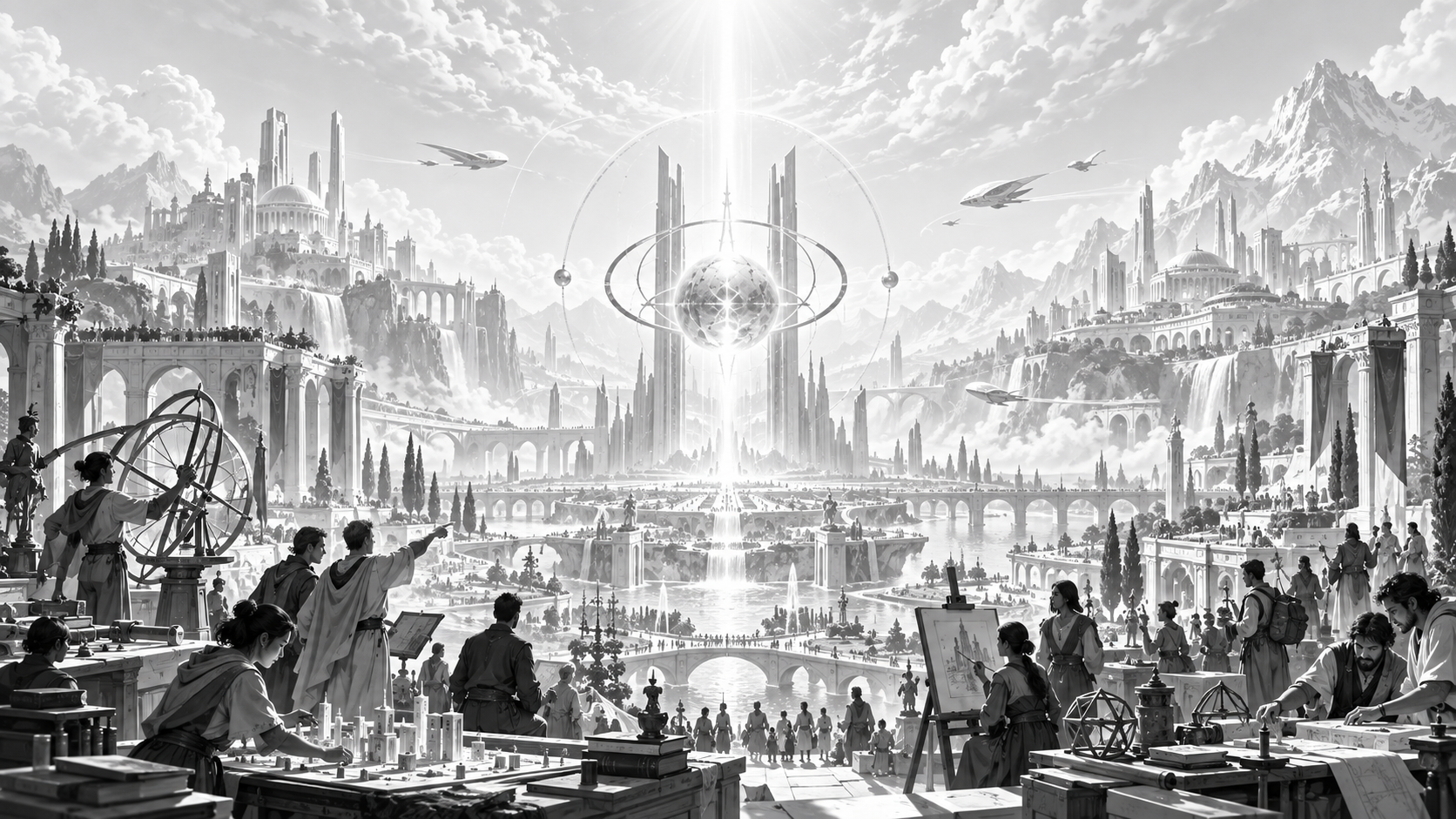
The child stood in a public workshop at the edge of one of the new Qorpra cities. Around her, an architect shaped a bridge, a biologist modeled a living system, a teacher built an interactive lesson, a small team tested a medical device, a musician composed an environment that reacted to motion, and a group of students trained an agent to help them explore a problem none of them yet knew how to solve.
None of this seemed miraculous anymore.
That was the miracle.
The Cities Beyond the Workshop
In the second age, the workshop had become the symbol of human priority. Machines waited until people chose what mattered. Tools gathered around intention rather than forcing intention to bend around tools.
By the sixth age, the workshop had escaped its walls.
It had become the city.
Every district contained places where people could make things that once demanded entire institutions. Schools could build systems rather than merely teach how other people had built them. Small companies could reach machine capability that had previously belonged only to vast organizations. Researchers could move from mathematical idea to executable experiment without crossing a maze of unrelated technological kingdoms. Artists could work with simulation, sound, graphics, sensors, intelligence and physical devices without surrendering authorship to the machinery underneath.
The old world had believed that increasing technological power would necessarily concentrate creation into fewer hands.
Qorpra asked whether the opposite could be designed.
The purpose of a powerful system is not to make creators unnecessary. It is to make more people capable of creation.
The Last Inequality
The old kingdoms had once been separated by technical layers.
But there had always been another border—older, quieter and more human.
Some people could imagine and build.
Others could imagine, but the path to building was too expensive, too fragmented, too specialized, too inaccessible or too heavily guarded.
This was the last inequality of the old computational world:
the distance between the ability to imagine and the ability to create.
It appeared everywhere.
A student could understand a scientific idea but lack the infrastructure to test it.
A doctor could see a better workflow but not possess a software organization capable of producing it.
A small manufacturer could understand its machines perfectly yet remain trapped behind proprietary tooling.
A community could understand its own needs better than any distant vendor, while lacking the technical bridge required to turn that knowledge into systems.
An independent developer could have an idea with global value but spend most of the journey negotiating build systems, deployment boundaries, platform policies, language transitions and operational complexity.
None of these people lacked imagination.
They lacked continuity.
The Right to Create
The builders of the sixth age began speaking of creation differently.
They did not call it a privilege granted by a platform.
They called it a capability that technology should expand.
Not every person needed to become a systems engineer.
Not every person needed to understand silicon.
Not every person needed to design an operating system, an agent runtime, a deployment network or a compiler backend.
But a person with a legitimate idea should not be blocked merely because the idea crossed those boundaries.
The system should carry complexity on their behalf until the moment they deliberately choose to descend into it.
The ability to imagine should no longer be separated from the ability to create.
This did not remove expertise.
It made expertise composable.
Experts could encode new capability into the living ecosystem. Other creators could then use that capability without rebuilding the world beneath it. When deeper control was necessary, the abstraction remained permeable. The expert was not erased. The expert's reach multiplied.
A Civilization of Creators
The phrase began as a metaphor.
Then it became a description.
In the old world, civilization consumed software produced by a comparatively small technical priesthood.
In the Qorpra world, more people became participants in computation itself.
A farmer could build a domain extension that understood the rhythms of irrigation and soil.
A roboticist could publish a safe physical-control capability without forcing users to rebuild the underlying device stack.
A linguist could extend semantic tools for a language community ignored by larger platforms.
A scientist could package a new computational model as a first-class capability instead of leaving it trapped in a paper or laboratory script.
A teacher could distribute an interactive learning system as easily as earlier generations distributed a document.
A game designer could cross simulation, networking, AI, native performance and device input without leaving the intellectual universe of the idea.
A small company could operate globally without first becoming an infrastructure company.
And a child could encounter programming not as a catalogue of arbitrary barriers, but as a way of describing what should exist.
This was not the end of professional engineering.
It was its expansion.
The New Guilds
As repetitive work diminished, new guilds appeared.
Some built Feature Plugins that taught Qorpix new semantics.
Some created target packs for machines no original Qorpra architect had seen.
Some built migration systems capable of carrying entire software civilizations forward without abandoning their accumulated knowledge.
Some created verification packs, making trust a reusable capability.
Some designed agent workflows that could coordinate complex work without obscuring responsibility.
Some built Device Link transports for laboratories, factories, vehicles, homes and machines at the edge of the network.
Some created Studio extensions that turned specialized professional knowledge into accessible tools.
Some worked on runtimes, kernels, databases, distributed systems, scientific computation, graphics, hardware support or domains that had not yet acquired names.
The old story of automation had predicted a shrinking world of creators.
The sixth age discovered the opposite possibility.
When creation becomes easier, humanity does not run out of things to build. It discovers more things worth building.
Developer Continuity
Qorpra had always treated developer continuity as more than employment policy.
It was architectural ethics.
If a technology became more capable by making the people who understood it economically irrelevant, it had created a brittle victory. The knowledge that kept the ecosystem healthy would eventually disappear with the incentives that sustained it.
So the sixth age asked a different question whenever automation advanced:
Where does human value move next?
If an agent could generate routine code, developers could design stronger abstractions.
If migrations could become automatic, migration engineers could build the systems that made entire ecosystems portable.
If deployment became invisible, infrastructure specialists could encode resilience and security into the platform itself.
If interfaces became easier to generate, designers could spend more attention on experience, meaning and accessibility.
If machines could perform larger portions of execution, humans could move toward architecture, verification, judgment, invention and stewardship.
The goal was not to protect every old task forever.
It was to protect the continuity of human contribution while the tasks evolved.
Contribution, Not Extraction
A living ecosystem required more than technical extensibility.
It required an economic philosophy.
The old platforms had often invited builders to create value on roads they did not own, under terms they could not influence, in markets where the platform could become both landlord and competitor.
Qorpra could not claim to be human-first while repeating that structure.
So a principle entered the doctrine:
Those who expand the world should be able to share in the value that expansion creates.
This did not mean every contribution had to be commercial.
Open-source work remained essential.
Public knowledge remained essential.
Shared infrastructure remained essential.
But when a builder chose to create a paid capability, a professional extension, a verified domain pack or a service used throughout the ecosystem, the architecture should make sustainable participation possible.
Economic continuity became another form of technical continuity.
The Commons and the Market
The sixth age learned that a healthy ecosystem needed both.
A commons without sustainability could exhaust the people who maintained it.
A market without a commons could enclose the world until innovation required permission.
So Qorpra treated the two as complementary institutions.
The commons preserved shared foundations.
The market rewarded differentiated contribution.
Open standards preserved mobility.
Trust systems preserved provenance.
Compatibility rules protected continuity.
And the right to leave prevented participation from becoming captivity.
Education Without Gatekeeping
One of the most visible changes appeared in education.
The old curriculum had often taught technology as a sequence of disconnected toolchains.
Students learned one environment for interfaces, another for servers, another for data, another for systems, another for devices, another for machine learning, another for deployment.
They learned the boundaries before they learned the continuum.
In the sixth age, education could begin somewhere else.
With intent.
What do you want the machine to do?
What does the user need?
What must be safe?
What must be fast?
What must be explainable?
Which layer matters now?
Only then did the learner descend.
The system remained deep, but the path through that depth was coherent.
Students did not need to memorize the accidental borders of a previous century before they were permitted to create.
Local Power, Global Reach
A coherent platform also changed the geography of creation.
Capability no longer had to be concentrated wherever the largest engineering organizations were located.
A small team could operate from a village, a university laboratory, an independent studio, a factory floor or a city far from traditional technology centers.
Local knowledge could remain local in origin while reaching global scale.
Languages, cultures, industries and communities previously treated as edge cases could encode their own needs into first-class capabilities.
Qorpra's unity was not meant to flatten difference.
It was meant to make difference interoperable.
The Human Dividend
For generations, productivity had often been measured by how much more output could be extracted from the same person.
The sixth age proposed a better measure.
How much more possibility could a person reach?
Could a scientist test more hypotheses?
Could a designer explore more forms?
Could a small company compete without reproducing a giant company's infrastructure?
Could a developer understand the consequences of a change across the whole system?
Could a student build something real before bureaucracy convinced them that creation belonged to experts somewhere else?
Could a community shape the technology that governed its own life?
This was the human dividend.
Not more machine activity for its own sake.
More human reach.
The Civilization of Creation Doctrine
If the sixth age must be reduced to principles, let them be these:
- Creation should become easier without becoming less serious.
- Expertise should multiply through reusable capability, not disappear behind automation.
- Human value should move upward as repetitive work moves downward.
- Local knowledge should be able to achieve global reach.
- Access to creation should expand faster than the complexity of technology.
- Builders who expand the ecosystem should be able to share in the value they create.
- The commons and the market should strengthen one another rather than consume one another.
- Education should teach continuity before accidental boundaries.
- Technology should increase the number of meaningful questions people can pursue.
- A civilization becomes more creative when more of its people can turn intent into reality.
Phase VI
At the end of the sixth legend, the old battlefield is visited one final time.
No armies remain.
No banners divide the horizon.
The land where kingdoms once faced one another has become a city.
Near the place where the first beam descended, a public workshop stands open.
Inside, an elderly engineer teaches a child how to inspect the machine beneath an abstraction.
At another table, an artist and an agent are building a world together.
Across the hall, a scientist publishes a new capability to the registry.
A small team tests a device that will be used far beyond their city.
A student discovers a problem no existing Feature Plugin can express and begins designing one.
Nobody calls this extraordinary.
They call it Tuesday.
The child from the beginning of the story looks toward the sky.
She has heard the old legend of the light descending between the armies.
She asks the engineer where the light went.
The engineer does not point upward.
He points around the room.
To the people.
To the tools.
To the open doors.
To the machines waiting for direction.
To the ideas becoming real.
And he says:
It stopped being something we waited for.
The child looks at her own hands.
The light is there.
Not as magic.
As capability.
As agency.
As responsibility.
As the right to create.
The first age unified the layers.
The second restored the human center.
The third taught the system to evolve.
The fourth gave intelligence a lawful place.
The fifth carried intention into matter.
And the sixth gave that continuum back to civilization.
The world no longer asks which kingdom technology belongs to.
It asks what humanity will choose to build with it.