


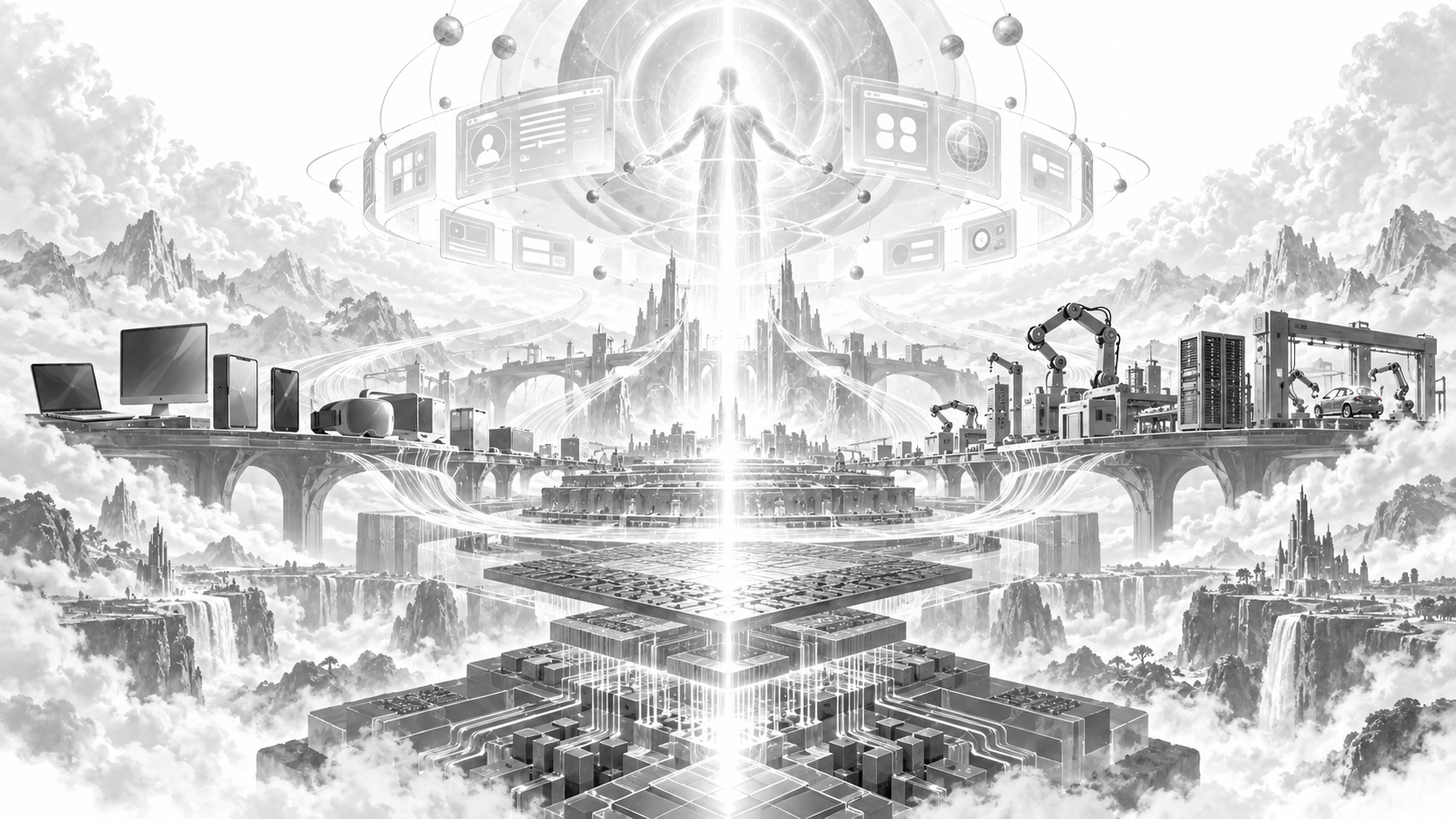
The fifth age began with a strange realization.
Qorpra had unified software.
It had placed the human at the center.
It had learned to evolve.
It had given intelligence a lawful place in the system.
Yet one border remained.
The oldest border of all.
The border between an idea and matter.
The Last Wall
For centuries, software had lived behind glass.
A person touched an interface.
A program responded.
Networks moved information.
Clouds coordinated distant machines.
But beneath every abstraction waited the physical world.
Processors switched.
Memory charged and discharged.
Radios moved energy through air.
Motors turned.
Sensors measured heat, pressure, light, position and motion.
Robots moved through rooms.
Vehicles crossed roads.
Machines shaped metal.
Medical devices touched bodies.
At the bottom of every digital kingdom, matter had always been listening.
The old world treated this final descent as a separate discipline.
To reach it, creators changed languages, toolchains, runtimes, operating systems, deployment models and mental models.
The closer software came to matter, the more the original human intention seemed to dissolve into special cases.
The Qorpra world had promised something else.
From UI to silicon.
Eventually the promise had to become literal.
The Descent
The fifth legend tells of a staircase discovered beneath the Qorpra tree.
No map showed where it ended.
The first steps passed through applications.
Then runtimes.
Then the operating system.
Then drivers.
Then instruction sets.
Then electrical boundaries where software names disappeared and only physical state remained.
At the bottom was a black stone etched with a single question:
Can one intention survive all the way down?
The architects hesitated.
They had spent generations making the upper world easier to understand.
Perhaps the physical layer should remain hidden forever.
The machine smiths disagreed.
What cannot be reached cannot be mastered.
What cannot be inspected cannot be trusted.
What cannot be expressed becomes someone else's kingdom.
So the creators carried the Qorpra light down the staircase.
Qorpix went with them.
From Software to Matter
The philosophy of the fifth age is Material Continuity.
It does not claim that a user interface and a processor instruction are the same thing.
They are radically different.
It claims that they belong to one causal chain.
A button press can eventually change a transistor state.
A policy can eventually change a packet.
A simulation can eventually change a motor.
An agent decision can eventually change a physical environment.
If one intention can produce consequences across that entire chain, then the architecture should help us reason across that chain too.
The abstraction layers remain.
The blindness does not.
From UI to silicon is not the removal of layers. It is the restoration of continuity between them.
Qorpra OS — The Ground Beneath the Ecosystem
A universal computing ecosystem eventually reaches the question every platform avoids until it cannot:
What lies beneath the runtime?
Qorpra OS is not imagined as another operating system merely competing for a desktop.
It is the ground layer of the philosophy.
A system designed around native observability.
A system where deployment, devices, isolation, processes, networking and intelligence can be understood as parts of one continuum rather than separate administrative worlds.
A system that can scale downward toward small machines and upward toward virtualized infrastructure.
A system that treats restart-heavy configuration, opaque state and accidental operational complexity as design problems rather than traditions.
Its purpose is not to own the machine.
Its purpose is to make the machine legible to the ecosystem above it.
Device Link — The Bridges Leave the Screen
The first Qorpra story was full of bridges between computational kingdoms.
In the fifth age, those bridges reach physical devices.
A phone on a desk.
An embedded board.
A robot in a laboratory.
A vehicle.
A wearable.
A remote machine in a device farm.
A system across the room or across the planet.
Qorpra Device Link represents a simple idea:
If a device is a target of human intention, then discovery, pairing, installation, launch, logs, debugging, profiling and controlled update should feel like one coherent relationship.
Different transports may exist.
USB.
Serial.
Network.
A local bridge where platforms require one.
Cloud infrastructure where distance requires it.
The physical mechanisms may differ.
The developer should not have to rebuild the concept of a device every time the transport changes.
This is another form of continuity.
The Runtime Packs
As Qorpix descended toward matter, it encountered a truth the upper layers had hidden.
Machines are not abstract.
Architectures differ.
ABIs differ.
Operating environments differ.
Memory systems differ.
Instruction sets differ.
Embedded constraints differ.
WebAssembly differs from native silicon.
AArch64 differs from x86-64.
A board in a factory differs from a server in a datacenter.
Unity cannot mean pretending those differences do not exist.
So Qorpra does not solve portability by forcing every machine into the lowest common denominator.
It carries a common semantic world into target-aware runtime packs.
Each target can speak in its native accent.
Memory can be implemented appropriately.
Strings and collections can retain common meaning while using efficient machine-specific mechanisms.
Filesystem and process behavior can map into the environment honestly.
The language remains one.
The machine code does not have to be.
Native Means Responsibility
The closer the system comes to matter, the less room there is for pretending costs do not exist.
Allocations have consequences.
Memory layout has consequences.
Calling conventions have consequences.
Cache behavior has consequences.
Instruction selection has consequences.
Latency has consequences.
Power has consequences.
Safety failures may have physical consequences.
Qorpix therefore cannot use “high level” as an excuse for ignorance.
The fifth age requires a language that can provide abstraction without erasing responsibility.
A developer may choose not to descend into the details.
But the system itself must understand them.
And when the developer does need to descend, the path must exist.
This is how high-level expression and low-level performance stop being rival kingdoms.
The Compiler as a Bridge to Reality
In earlier ages, the compiler was treated as a translator.
Source code entered.
Machine code left.
In Qorpra, the compiler becomes more than translation.
It is the institution responsible for preserving intention while the representation changes.
Types become layouts.
Control flow becomes instructions.
Effects become constraints.
Abstract operations become target-specific sequences.
High-level guarantees must survive lowering.
Optimization must improve execution without changing meaning.
Security boundaries must not evaporate because the representation became harder for humans to read.
The compiler stands at the point where philosophy meets physics.
Its job is to make abstraction real without making reality unrecognizable.
No Hidden Empire Beneath the Language
Many modern languages eventually depend on an enormous lower world they do not control.
A runtime written elsewhere.
A compiler backend owned by another architecture.
A linker treated as mysterious infrastructure.
A foreign systems language required for the deepest layers.
Those choices can be practical.
But they can also establish a hidden empire beneath the language.
The fifth age of Qorpra aims for ownership of the full path where ownership matters.
Not because every existing tool is bad.
Not because rebuilding everything is automatically virtuous.
But because a language that claims continuity from UI to silicon must understand the path to silicon deeply enough to evolve it.
The lower layers cannot remain permanently sacred and inaccessible.
Where native ABI interoperability is necessary, Qorpra can meet the world as it exists.
But the long-term center of gravity remains its own architecture.
The Silicon Horizon
Eventually the staircase reaches its final visible step.
Silicon.
Not as a marketing metaphor.
As the material on which intention becomes physical switching.
At this boundary, the distinction between software platform and hardware architecture becomes thinner.
Compiler knowledge can inform instruction selection.
Runtime design can inform memory systems.
Language semantics can inform accelerator interfaces.
Telemetry can reveal patterns from applications all the way down to hardware behavior.
A future Qorpra system might target processors that do not yet exist.
It might help define them.
The objective is not necessarily to manufacture every chip.
It is to ensure that the programming model is not permanently limited by assumptions inherited from yesterday's hardware.
The language should be able to meet new matter when new matter arrives.
The Physical Responsibility Doctrine
The fifth age introduces an ethical consequence as well.
When software remains on a screen, failure can still be costly.
When software controls matter, the stakes can become immediate.
A device can injure.
A vehicle can move.
A medical system can affect a life.
An industrial controller can alter a physical environment.
An intelligent agent can trigger actions whose consequences cannot be undone with a database rollback.
So material continuity requires physical responsibility.
Permissions must become more precise, not less.
Simulation becomes more valuable.
Verification becomes more important.
Observability must cross the software/hardware boundary.
Safe failure states matter.
Human authority must remain appropriate to the consequence.
The closer Qorpra comes to matter, the more seriously it must treat trust.
One Language Does Not Mean One Machine
There is a seductive mistake hidden inside universal-platform thinking.
If one language can target everything, perhaps everything should become the same.
Qorpra rejects this.
A web browser is not an embedded board.
A phone is not a datacenter.
A game console is not a medical device.
A real-time controller is not a batch-processing server.
Universal reach means the language understands context deeply enough to respect differences.
Not that it erases them.
This is the same lesson from the first war, carried all the way down:
Unity without uniformity.
One language.
Many targets.
One ecosystem.
Many forms of matter.
One intention.
Many valid realizations.
The Material Doctrine
If Phase V must be reduced to a doctrine, let it be this:
Software and hardware belong to one causal continuum.
Abstraction should hide accidental complexity without hiding physical truth.
Portability should preserve semantics while respecting the native strengths and constraints of each target.
The compiler is responsible for carrying meaning toward matter.
A universal language must understand machines deeply enough to avoid reducing them to the lowest common denominator.
The lower layers should remain reachable, observable and evolvable.
Device interaction should form one coherent model even when transports differ.
Physical consequence requires stronger responsibility, verification and authority boundaries.
No hidden technological empire should permanently define the limits of the language beneath it.
From UI to silicon is a promise of continuity, not sameness.
Phase V
At the end of the fifth legend, a creator stands again before the empty page from Phase II.
But the page is no longer merely a page.
On it appears an idea.
The idea becomes Qorpix.
Qorpix becomes an interface.
The interface becomes behavior.
Behavior crosses a runtime.
The runtime crosses an operating system.
The operating system reaches a device.
The compiler lowers intention into instructions.
Instructions become electrical state.
Electrical state changes matter.
A motor turns.
A sensor responds.
A machine moves.
Something in the physical world is now different because a person imagined that it could be.
The creator walks down the ancient staircase.
At the bottom, the black stone is still there.
The question remains carved into it:
Can one intention survive all the way down?
The creator touches the stone.
The Qorpra light appears from the interface above, passes through every layer, and reaches the silicon below without breaking.
For the first time, the stone answers.
Yes.
Not because the layers disappeared.
Because they finally learned to belong to one another.
And the five ages reveal themselves as one story:
The first ended the war between layers.
The second returned purpose to the human.
The third taught the system to evolve.
The fourth gave intelligence a place without giving it the throne.
The fifth carried intention into matter.
The light that once descended from the sky now travels in both directions.
From human imagination to silicon.
From silicon back to human understanding.
A complete continuum.
A living system.
A language that can cross it.
Qorpra — One core. Every direction.
Qorpix — One language. Every layer.
From imagination to matter. From UI to silicon.