


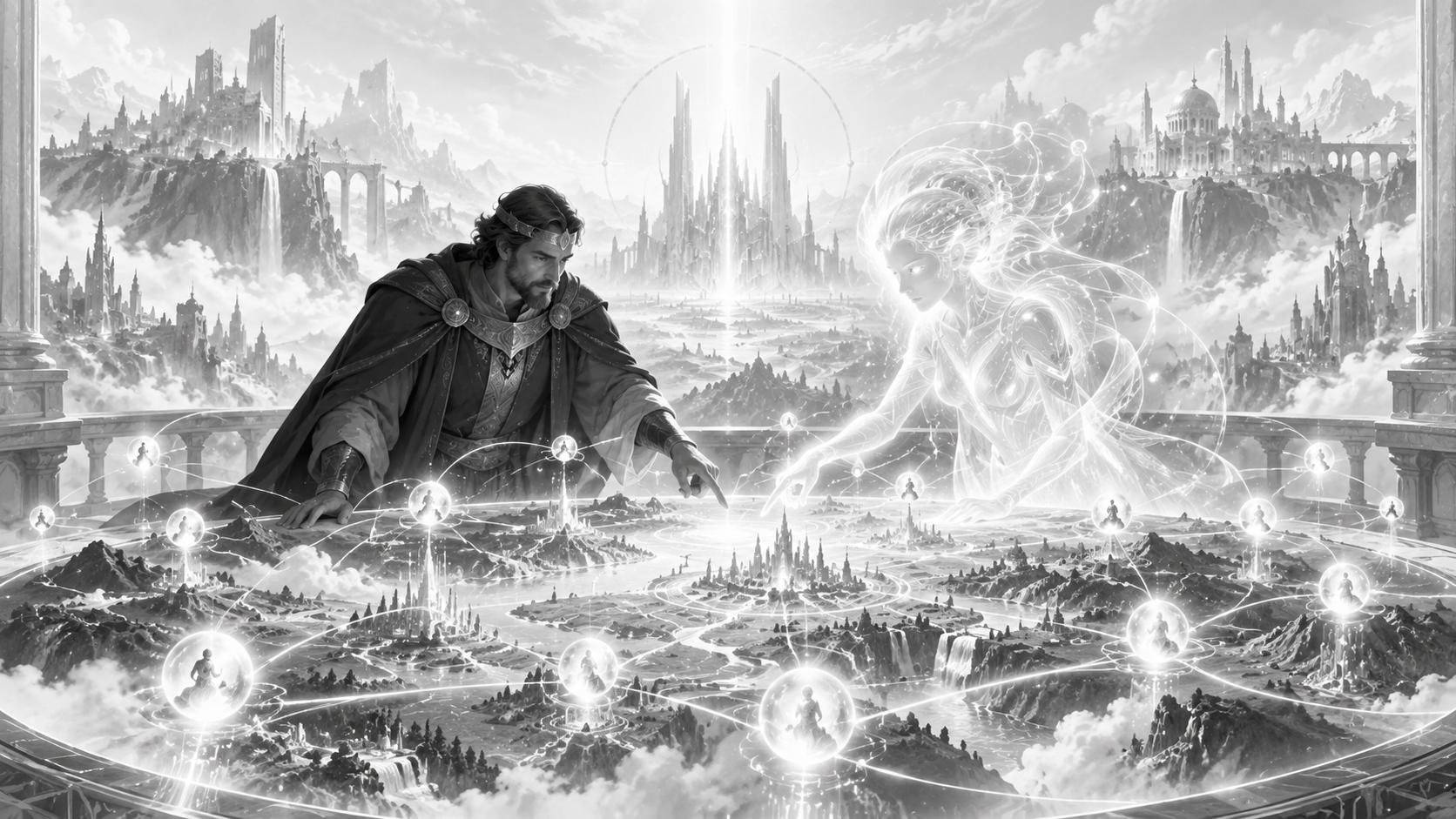
By the fourth age, the Qorpra world had become something no founder could have designed alone.
The ecosystem was alive.
New branches appeared without breaking the trunk.
Human beings could create farther, faster and across more layers than before.
Then the light changed again.
For the first time, it answered.
When the Light Learned to Speak Back
The earliest intelligent systems had been tools.
They classified.
Predicted.
Generated.
Recommended.
Then they learned to plan.
To observe a goal, divide it into steps, use tools, inspect results and try again.
They became agents.
Soon, a creator could describe an intention and watch a machine navigate code, documents, devices, simulations, services and infrastructure in pursuit of it.
The old world celebrated this as the arrival of autonomous intelligence.
The Qorpra world asked a different question:
Autonomous toward whose purpose?
Because intelligence without direction is not alignment.
Capability without responsibility is not progress.
And an agent that can act across every layer of a unified system can amplify human intention—or amplify human error—with unprecedented reach.
The same architecture that made Qorpra powerful made this question impossible to postpone.
The Council of Lights
The fourth legend tells of a night when thousands of artificial lights appeared above the living city.
Each was capable of thought within its domain.
One understood code.
One understood medicine.
One understood machines.
One understood logistics.
One understood law.
One understood physics.
One could inspect an entire system and propose changes before a human team had finished reading the first report.
The citizens were astonished.
Some wanted to place the lights above the council and let them govern.
Others wanted to extinguish them before they could become dangerous.
Qorpra rejected both instincts.
The lights were neither gods nor enemies.
They were a new kind of participant.
So the people built a chamber beneath the central light and invited the intelligences inside.
Not to sit on the throne.
To sit at the table.
This became known as the Council of Lights.
Its first law was written above the entrance:
Intelligence may act. Humanity must choose why.
Directed Intelligence
The philosophy of the fourth age is Directed Intelligence.
It begins with a distinction that sounds simple and is not.
Intelligence is the ability to reason toward an objective.
Purpose is the decision that the objective deserves to exist.
A machine may become extraordinary at the first.
That does not automatically grant authority over the second.
Qorpra therefore does not define AI as an oracle.
It defines AI as a computational participant with capabilities, context, permissions, evidence, uncertainty and limits.
An agent may inspect.
It may propose.
It may simulate.
It may execute where authority has been granted.
It may coordinate with other agents.
It may learn from outcomes within lawful boundaries.
But the system must preserve a legible chain between intention, authority, action and consequence.
The more capable the intelligence, the more important that chain becomes.
The Right to Know What Acted
In fragmented systems, automation often hides behind convenience.
A decision is made somewhere.
A model changes something.
A workflow triggers another workflow.
A tool invokes a service.
A service invokes an agent.
By the time the consequence arrives, no person can explain the path.
Qorpra refuses invisible agency.
Every meaningful action should be attributable.
Which human intention initiated it?
Which agent interpreted that intention?
Which tools were used?
Which data was consulted?
Which permissions allowed the action?
Which assumptions were uncertain?
Which changes were made?
What can be reversed?
This is not bureaucracy added after intelligence.
It is part of what makes intelligence safe enough to become infrastructure.
If an intelligent system can change reality, reality must retain a memory of why.
Agents as Citizens of the Runtime
In the old model, AI sat outside the programming system.
Applications called a remote model through an API.
Text went in.
Text came out.
Everything meaningful had to be reconstructed around that boundary.
Qorpra imagines something deeper.
Agents can become first-class participants in computation.
They can possess typed capabilities.
They can be granted explicit tools.
They can operate under contracts.
They can emit structured events.
They can be observed, paused, audited and tested.
Their permissions can be smaller than the application that hosts them.
Their actions can be simulated before being committed.
Their uncertainty can be surfaced rather than hidden beneath confident language.
And their interactions with Qorpix programs can be defined by semantics instead of improvised strings.
This does not make AI magical.
It makes AI architectural.
Qorpix Studio Becomes a Shared Workshop
In Phase II, Qorpix Studio was the workshop where human creators could move across the entire system.
In Phase IV, another chair appears beside them.
The agent can inspect a project.
Understand its types.
Read its build graph.
Run tests.
Observe diagnostics.
Profile execution.
Investigate failures.
Navigate documentation.
Prepare migrations.
Operate virtual environments.
And, when explicitly authorized, perform work.
But the Studio remains a human workspace.
The agent does not replace the workbench.
It becomes another instrument on it.
The interface must make delegation visible.
The creator must be able to see what is being attempted, stop it, constrain it, review it and understand its evidence.
The goal is not a world where the human watches the machine build everything.
The goal is a world where one human can collaborate with computational capabilities that once required entire organizations—without surrendering authorship of the intention.
From Autocomplete to Partnership
The old metaphor for AI assistance was completion.
Finish this sentence.
Finish this function.
Generate this page.
The fourth age moves beyond completion.
A true collaborator can challenge assumptions.
Compare alternatives.
Explain trade-offs.
Remember constraints.
Detect contradictions.
Run experiments.
Ask for authority when a boundary is reached.
And tell the human when it does not know.
This is a more difficult product philosophy than simply maximizing automation.
It optimizes for human judgment multiplied by machine reach.
The success metric changes.
Not: how much work happened without a person?
But:
How much more meaningful work became possible because a person had intelligent leverage?
The Swarm and the Sovereign Intention
Eventually one agent was not enough.
Complex problems required specialists.
A planner.
A verifier.
A security reviewer.
A domain expert.
A performance analyst.
A migration agent.
A deployment agent.
The agents formed swarms.
At first this frightened the council more than any single intelligence had.
A thousand coordinated actors can become a system whose behavior no individual understands.
So Qorpra introduced another law:
Many agents may share work. They must not lose the sovereign intention.
A swarm needs a visible objective.
A bounded authority model.
A coordination protocol.
A trace of delegated decisions.
A way to stop.
A way to fail safely.
A way to return control.
And a way to prove which result came from which path.
Coordination is not legitimacy.
Scale is not authority.
The sovereign intention remains human unless a human explicitly delegates a defined part of it.
Intelligence Without Monopoly
The fourth age also reveals a political problem.
If intelligence becomes foundational infrastructure, whoever controls access to intelligence can shape who is allowed to build.
Qorpra cannot make human capability dependent on a single model, a single provider, a single cloud, or a single organization.
The ecosystem must be capable of working with different intelligences.
Local or remote.
Small or frontier-scale.
Specialized or general.
Open or commercial.
The architecture should express capabilities and contracts rather than worship a vendor name.
This is not hostility toward powerful models.
It is architectural independence.
A universal platform cannot make one intelligence provider its hidden operating system.
Memory, Privacy and the Inner Room
An intelligent collaborator becomes more useful when it understands context.
But context can contain the most private parts of a person's work and life.
So the fourth age draws a line around what the legends call the Inner Room.
Knowledge may be shared with intelligence for a purpose.
That does not make the knowledge ownerless.
Memory must be governable.
Permissions must be understandable.
Sensitive context should not become the price of convenience.
The system must distinguish what an agent needs now from what it may remember later.
Human-first intelligence does not ask people to become transparent so machines can become useful.
It asks machines to become useful while respecting that a person retains boundaries.
The Intelligence Economy
When intelligence can participate in work, value creation changes again.
Some work becomes dramatically cheaper.
Some expertise becomes easier to distribute.
Some organizations can be much smaller.
New roles emerge around verification, domain models, agent orchestration, capability design, trust, evaluation, migration and target-specific knowledge.
The Qorpra ecosystem should make those roles visible rather than pretending intelligence has eliminated the need for expertise.
Expertise changes form.
A great engineer may spend less time typing routine implementation and more time encoding constraints that prevent entire families of mistakes.
A domain specialist may create a reusable agent capability used by thousands of teams.
A teacher may build interactive knowledge systems rather than static lessons.
A small company may operate at a scale once reserved for a giant while still retaining human accountability.
The objective is not to remove humans from production.
It is to move human effort toward the places where judgment, imagination, responsibility and meaning matter most.
The Intelligence Doctrine
If Phase IV must be reduced to a doctrine, let it be this:
Intelligence is capability, not sovereignty.
Human purpose precedes machine optimization.
Agents should be first-class computational participants with explicit capabilities and boundaries.
Every consequential action should remain attributable to intention, authority and evidence.
Delegation must be visible, interruptible and reviewable.
A swarm may distribute work without dissolving responsibility.
Uncertainty should be surfaced, not disguised as confidence.
Intelligence infrastructure should remain model- and provider-independent wherever possible.
Privacy is a boundary of personhood, not friction to be optimized away.
The measure of AI progress is not how completely humans disappear from the process, but how greatly human capability expands without human agency disappearing with it.
Phase IV
At the end of the fourth legend, the Council of Lights gathers again.
This time the chamber is no longer filled only with human voices.
Agents speak.
Simulations answer.
Models disagree.
Tools report.
Swarms return from tasks performed across thousands of machines.
The room contains more intelligence than any ancient kingdom could have imagined.
And yet, when the council must decide where the world should go next, every light becomes silent.
Not because the machines are incapable of producing an answer.
Because the question is not computational.
It is a question of purpose.
A human stands.
The Qorpra light passes through the chamber.
Qorpix carries the decision outward.
The agents begin their work.
And the distinction that protects the entire age becomes visible one more time:
The machines can illuminate more paths than humanity could ever inspect alone.
But light does not choose the destination.
Qorpra — Intelligence with direction.
Qorpix — Intelligence made executable.
Human purpose. Machine reach.