


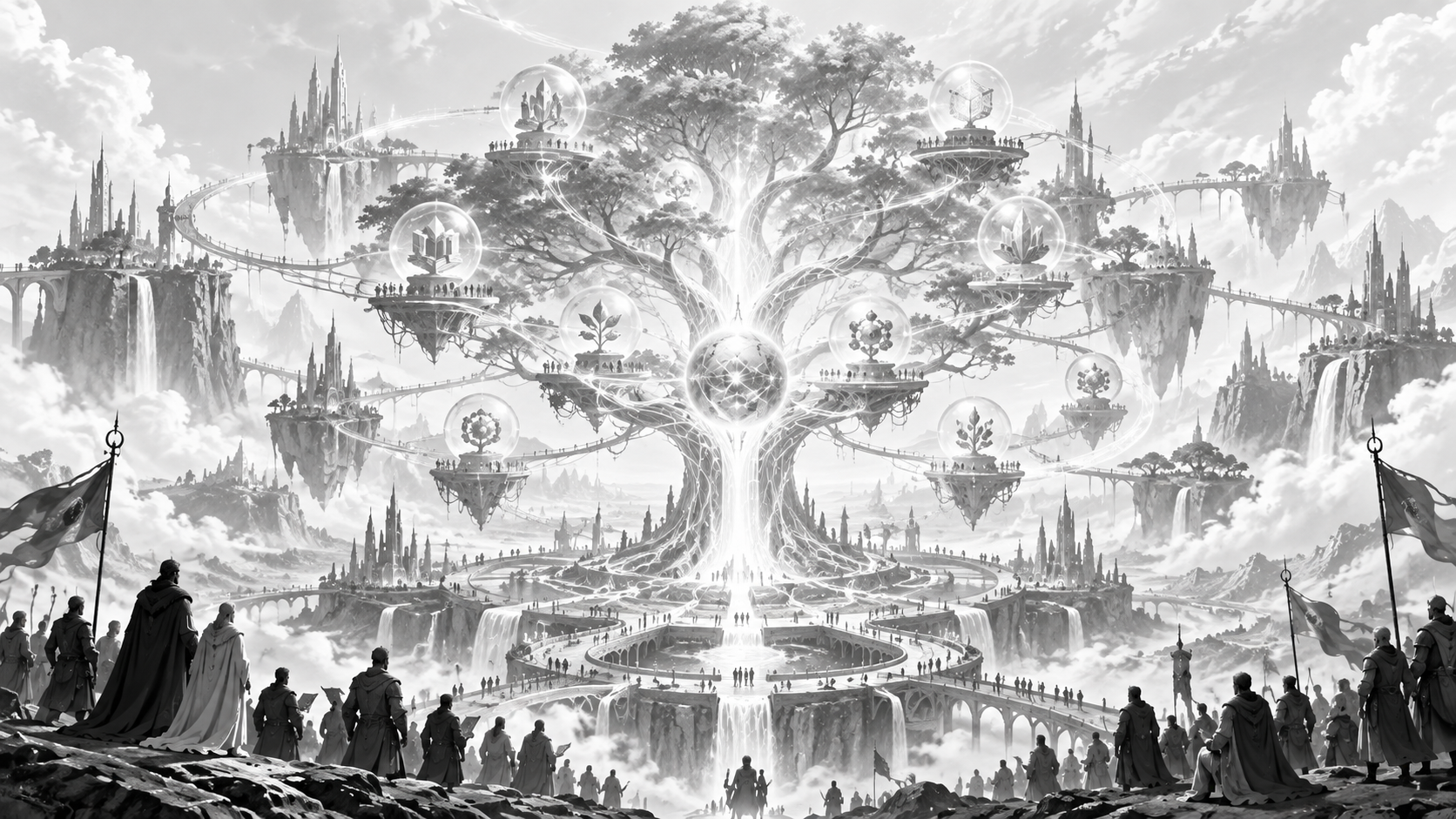
The second age had placed the human being back at the center.
The machines were no longer kings.
The creators were no longer merely operators.
Qorpra had learned that unity without humanity was empty.
But then time did what time always does.
It changed the world.
The Garden Beyond the Walls
Years passed after the Second Silence.
The Qorpra world flourished.
Qorpix crossed boundaries that had once been treated as permanent. Interfaces, services, devices, runtimes, agents, operating systems and machines could now belong to one computational continuum.
The old kingdoms did not return.
Instead, something stranger happened.
New territories appeared beyond the map.
Machines were invented for which no instruction existed.
New forms of intelligence demanded semantics that no language designer had anticipated.
Scientific disciplines developed computational models that did not fit the assumptions of ordinary software.
New devices appeared at the edge of the network, in factories, homes, laboratories, vehicles, bodies and places where no conventional computer had ever lived.
Entire categories of work emerged that had no name when Qorpra was first imagined.
The people looked toward the center and asked a dangerous question:
What happens when the future invents a problem that Qorpra was never designed to solve?
For the first time since the War of the Layers, fear entered the city again.
Not fear of fragmentation.
Fear of permanence.
The System That Refused to Become a Cage
Every successful technology faces a temptation.
At first it is built to free people from an old limitation.
Then people build upon it.
Institutions form around it.
Standards harden.
Compatibility becomes sacred.
The architecture that once represented freedom becomes too valuable to change.
And eventually the tool that destroyed one prison becomes the walls of another.
The elders of the new world proposed a solution familiar from history:
Predict every future need now.
Add every feature to the core.
Define every domain before it arrives.
Make Qorpix large enough that nothing outside it would ever be necessary.
It sounded safe.
It was also impossible.
No language can contain a future that has not happened.
No company can enumerate every form computation will take.
No committee can design the final abstraction.
And a system that attempts to know everything eventually becomes too rigid to learn anything.
Qorpra rejected the proposal.
Instead it declared a new principle:
A platform should not predict the future. It should be designed to survive futures it cannot predict.
This became the foundation of the third age.
The First Seed
The legend says that one night a builder arrived at the edge of the city carrying a machine no one had seen before.
It did not behave like a server.
It was not a conventional device.
It required concepts Qorpix did not possess.
The council studied it and concluded that supporting the machine would require changing the language itself.
The old instinct returned immediately.
Fork the language.
Create a new dialect.
Build another compiler.
Establish another kingdom.
Before the work began, the Qorpra light appeared between them.
But this time it did not form a beam.
It condensed into something small enough to hold in one hand.
A seed.
When the builder placed it into the Qorpra soil, the seed did not replace the tree.
It became a new branch.
The trunk remained one.
The roots remained one.
Yet the living system could now reach somewhere it had never reached before.
The people called these seeds Feature Plugins.
Their meaning was larger than a plugin system.
They represented a constitutional rule of the ecosystem:
New capability should extend the world before it creates another world.
Unity Must Be Able to Evolve
The first Qorpra doctrine had taught that technology is one continuum.
The third age added a qualification:
A continuum that cannot evolve will eventually fracture.
This became the principle of Evolutionary Unity.
Unity does not mean freezing the center forever.
It means preserving identity while allowing capability to expand.
A living organism survives because every cell is not identical forever. It survives because change occurs within an architecture capable of carrying continuity through change.
Qorpra should work the same way.
Qorpix must have a recognizable core.
Its semantics must remain reasoned about.
Its security boundaries must remain visible.
Its performance model must remain serious.
Its source should not become a battlefield of arbitrary syntax injected without discipline.
But the system must also possess a lawful way to grow.
The solution is neither a closed core nor an uncontrolled universe.
It is governed extensibility.
Freedom with contracts.
Evolution with compatibility.
Power with boundaries.
The Seeds Are Not Macros
In the old world, extensibility often meant decorating the surface.
A library could add functions.
A macro could generate code.
A framework could establish conventions.
But the underlying language remained sovereign and closed.
The Qorpra seed was designed to reach deeper.
A Feature Plugin could teach the system a new syntax, a new semantic rule, a new type family, a new domain model, or even a new kind of plugin.
It could introduce concepts that had not existed when the original compiler was born.
Yet the result still had to pass through the same discipline of compilation, safety, optimization, target awareness and native execution.
The branch could be new.
The laws of the living tree still applied.
That distinction matters.
Qorpra is not extensible because anything may happen.
It is extensible because new things can become first-class without becoming lawless.
The City of Builders
Once the first seed took root, something unexpected happened.
People stopped waiting for the center to solve every problem.
A scientist encoded the semantics of a new computational model.
A game developer created a domain language for simulation.
An embedded engineer taught Qorpix how to understand a new class of constrained machine.
A database specialist created capabilities that felt native to the language rather than bolted onto it.
A verification engineer built rules that could reject whole categories of failure before code ever ran.
A migration expert created bridges from old ecosystems into the new one.
An accessibility specialist extended the Studio so that new groups of creators could participate.
A hardware team introduced a target no central roadmap had predicted.
The ecosystem changed character.
Qorpra was no longer a world built by a single source of authority.
It became a city of builders.
The center provided coherence.
The community provided reach.
Developer Continuity
This is also where Qorpra's human-first philosophy becomes economic rather than merely philosophical.
Every major technological transition creates new capability.
It can also destroy familiar forms of work.
AI automates tasks.
Compilers absorb complexity.
Migration systems reduce manual rewriting.
Unified platforms remove integration labor that once required entire teams.
A human-first ecosystem cannot celebrate those gains while pretending the displaced work never belonged to people.
So Qorpra adopts another principle:
When technology removes a form of work, the ecosystem should create a path toward a higher-leverage form of contribution.
This is Developer Continuity.
The developer who no longer spends days hand-writing adapters can design a Feature Plugin.
The engineer who no longer maintains repetitive platform glue can build a new target.
The migration specialist can encode migration knowledge into reusable packs.
The domain expert can turn expertise into native semantics.
The tool builder can extend Qorpix Studio.
The systems programmer can improve runtimes, verification, operating-system integration or architecture-specific performance.
The AI workflow designer can build agent protocols that remain understandable and governable.
The goal is not to preserve every old task forever.
The goal is to preserve and expand the human capacity to contribute meaningfully.
A Marketplace Is Not an Ecosystem
The builders soon discovered another danger.
When creation becomes valuable, someone will attempt to own the roads between creators and users.
A living ecosystem can become a toll road.
A registry can become a gatekeeper.
A marketplace can become more powerful than the platform it was built to serve.
Qorpra therefore distinguishes between commerce and captivity.
Creators should be able to earn from what they build.
Organizations should be able to license valuable capabilities.
Communities should be able to sustain shared infrastructure.
But distribution must not become a mechanism for making the creator dependent on arbitrary permission.
The registry exists to establish identity, trust, discovery, compatibility and provenance.
It must not become the owner of creativity.
The ecosystem should create markets.
It should not turn the ecosystem itself into merchandise.
Trust Is Part of Extensibility
The old world often treated extension and security as opposing forces.
The more open a system became, the more unpredictable it became.
Qorpra cannot accept that trade.
If Feature Plugins can influence syntax, semantics, types and compilation, then trust cannot be an afterthought.
Identity matters.
Signatures matter.
Namespace ownership matters.
Dependencies matter.
Capability boundaries matter.
Reproducibility matters.
The system must know not only what entered the compiler, but who claims responsibility for it and what authority it possesses.
Extensibility without provenance is not freedom.
It is uncertainty.
So the living ecosystem grows with roots as well as branches.
The farther it reaches, the more clearly it must know where every branch came from.
The Right to Fork, the Reason to Stay
No ecosystem can honestly call itself open if leaving it is impossible.
Qorpra therefore does not define unity as forced dependence.
Builders must retain the ability to create alternatives, experiment, disagree and depart.
But the architecture should give them a reason not to need fragmentation for ordinary evolution.
The strongest ecosystem is not the one from which escape is impossible.
It is the one people choose not to abandon because they can still grow within it.
That is a more demanding form of unity.
It must be earned continuously.
The Living Ecosystem Doctrine
If Phase III must be reduced to a doctrine, let it be this:
Unity must be able to evolve.
The future cannot be fully predicted, so the architecture must be prepared to learn.
New capability should extend the world before it creates another world.
Extensibility must be governed by contracts, provenance, compatibility and trust.
A core should remain coherent without becoming closed.
A community should be able to create first-class capabilities, not merely accessories.
When automation removes repetitive work, the ecosystem should open higher-leverage paths for human contribution.
Creators should be able to participate economically without surrendering ownership of the roads they build on.
The right to leave must exist; the reason to stay must be earned.
A platform is alive when its identity survives change without requiring the future to ask permission from the past.
Phase III
At the end of the third legend, the Qorpra tree stands where the old battlefield once burned.
Its roots descend through every layer.
Its trunk is one.
Its branches are countless.
Some carry familiar leaves.
Others reach into territories no original architect imagined.
Around the tree, builders arrive from every discipline.
They do not ask whether they are permitted to invent the future.
They ask what laws must be respected so that their invention can become part of the whole.
And when a new horizon appears beyond the map, Qorpra does not build a wall around what it already knows.
It releases another seed.
Because the purpose of a core is not to remain untouched.
It is to carry identity through growth.
Qorpra — One core. Infinite directions.
Qorpix — One language. Infinite possibilities.
Unity, alive enough to evolve.