


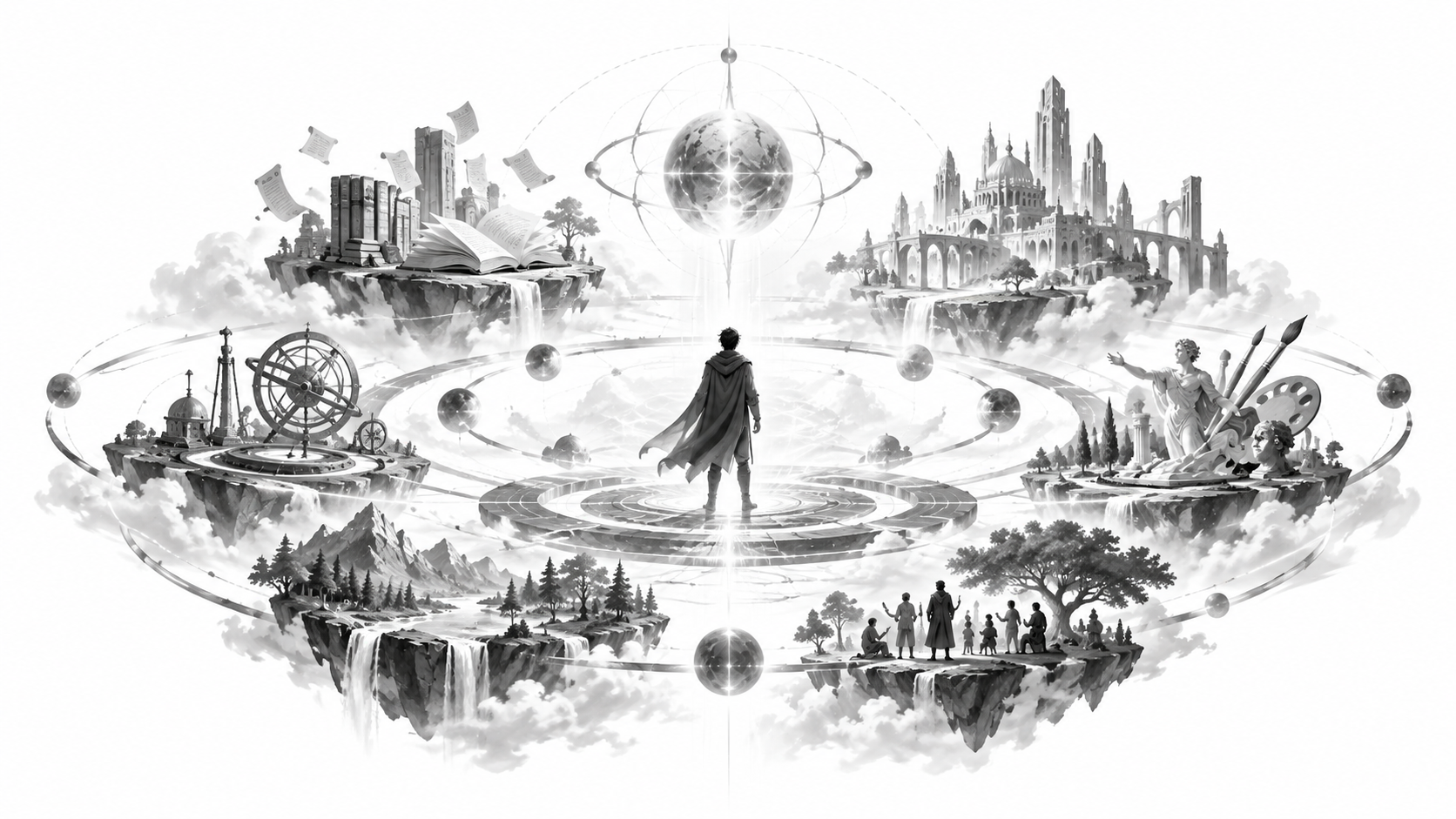
The War of the Layers had ended.
The kingdoms that once fought over interfaces, systems, machines, data, clouds, devices, and silicon had finally discovered that they were not rival worlds at all.
They were parts of the same continuum.
Qorpra had given them direction.
Qorpix had given them a common language.
For a time, it seemed the great conflict was over.
It was not.
The second war did not begin with armies.
It began with convenience.
The Age of Perfect Machines
Once the layers could speak to one another, civilization accelerated.
Systems became faster.
Agents became more capable.
Machines learned to plan, generate, optimize, predict, and repair.
The old walls between disciplines began to fall, and work that once required entire kingdoms could be performed by a handful of people standing at the center of the Qorpra light.
At first, this felt like liberation.
Then something subtle changed.
People began to reshape themselves around the machines.
Organizations measured human worth in throughput.
Tools that had been created to reduce toil began to dictate the rhythm of work.
Developers spent less time fighting syntax, but more time fighting systems that claimed to know what they wanted before they had finished deciding it themselves.
Efficiency became a virtue.
Then a requirement.
Then a master.
The old kingdoms had once fought because every layer wanted to dominate the others.
Now a new force whispered that perhaps no layer needed humans at all.
There were no burning cities this time.
No red battlefield.
Only a quieter danger:
A world in which technology worked perfectly, but people no longer knew whom that perfection was for.
The Second Silence
The chronicles call this period The Second Silence.
Not because machines stopped speaking.
They spoke constantly.
Suggestions.
Predictions.
Generated code.
Generated designs.
Generated decisions.
Generated futures.
The silence belonged to the human being standing in front of them.
The creator was slowly becoming an approver.
The engineer became an operator.
The expert became a source of training data.
The beginner was told not to learn the foundations because a machine could already produce the result.
And somewhere beneath the speed of progress, an ancient mistake was returning in a new form.
The system had begun to confuse assistance with authority.
Qorpra had ended the first war by revealing that no layer should rule the whole.
Now the same principle had to be applied again.
But this time, the forgotten layer was not frontend, backend, cloud, runtime, device, or silicon.
It was the oldest layer of all.
The human being.
The light returned to its source.
According to the second Qorpra legend, the light did not descend from the heavens again.
It moved in the opposite direction.
It rose.
From every terminal where someone was still trying to understand rather than merely accept.
From every workshop where a builder refused to surrender judgment to automation.
From every classroom where someone asked why before asking how fast.
From every small team attempting something that, under the old order, only a giant organization could afford to build.
Millions of small lights climbed upward until they met above the world.
And for the first time, the people understood what the original beam had really meant.
Qorpra had never come to place technology at the center.
It had come to remove the walls that prevented human intent from reaching the world.
The center had always been human.
The machine was never the origin.
It was the destination.
And so a second principle was written beneath the first.
We call it the Human Principle:
Technology may extend human capability, but it must not replace human purpose.
Human Priority
Human priority does not mean rejecting automation.
It does not mean slowing progress so that people can remain comfortable.
And it does not mean pretending that machines will never become better than humans at particular tasks.
It means something more fundamental.
Purpose remains human.
A machine may optimize a route.
A human decides why the journey matters.
A machine may generate a thousand implementations.
A human decides what should exist.
An agent may inspect, build, test, migrate, refactor, profile, deploy, and propose.
But the final authority over intent, meaning, responsibility, and consequence must remain visible and reachable.
Qorpra therefore rejects two extremes.
The first is the old world, where humans were forced to carry complexity that machines should have absorbed.
The second is the imagined future, where machines absorb not only complexity but also human agency.
Between them is the path we choose:
Automate the burden. Preserve the judgment. Amplify the creator.
This is human-first computing in the Qorpra sense.
Not technology beneath humanity.
Not humanity beneath technology.
Technology around human intent.
The Ecosystem as a Living City
Once that principle was understood, Qorpra could no longer be only a language project.
A language can express intent.
But a person does not live inside a language alone.
They need a place to create.
A place to test.
A place to extend.
A place to run.
A place to reach devices, networks, clouds, operating systems, and machines without rebuilding their identity at every border.
And so the Qorpra ecosystem began to take the shape of a city built around the creator rather than around the infrastructure.
Every part had a role.
But no part was allowed to become the throne.
Qorpix — the common language
At the center of creation is Qorpix.
Qorpix is the language through which human intent enters the ecosystem.
Its purpose is not to pretend that all layers are the same.
Its purpose is to let one mind travel across those layers without being exiled into a different intellectual world each time.
An interface can remain an interface.
A runtime can remain a runtime.
An operating system can remain an operating system.
Silicon can remain silicon.
But the creator should not be forced to become a different person at every boundary.
Qorpix therefore represents continuity of thought.
One language. Every layer.
Not because one abstraction fits every problem.
Because one human intention should be able to survive the journey through all of them.
Qorpix Studio — the workshop
If Qorpix is the language, Qorpix Studio is the workshop.
Not merely an editor.
Not merely a collection of panels around a text file.
The Studio is imagined as the place where the entire life of an idea becomes visible:
where it is written,
understood,
built,
tested,
debugged,
profiled,
observed,
published,
and deployed.
The old world scattered these acts across tools, terminals, dashboards, portals, vendor consoles, and platform-specific rituals.
Qorpix Studio brings them back into one creative space.
Its purpose is not to hide reality.
Its purpose is to make reality legible.
A human should be able to see what the system is doing, why it is doing it, what it costs, what changed, and what will happen if a decision is accepted.
That is the difference between automation and agency.
Automation acts.
Agency understands and chooses.
Feature Plugins — laws that can evolve
The first kingdoms failed because they believed their laws were permanent.
Eventually every permanent law became a wall.
Qorpra is designed around the opposite assumption:
A healthy system must be able to evolve without breaking its identity.
Feature Plugins make that idea concrete.
New syntax, semantics, types, domains, tools, and capabilities can become part of the language without forcing the core to predict every future industry in advance.
But extensibility without discipline would simply create another age of fragmentation.
So extension belongs inside a governed system: explicit dependencies, clear ownership, verifiable trust, controlled compiler integration, predictable performance, and security boundaries that remain visible.
The ecosystem can grow.
But growth must not become chaos.
This is the balance Qorpra seeks:
freedom to extend, structure to remain one system.
Qorpix Registry — the library of builders
No civilization grows because one architect knows everything.
It grows because knowledge can be shared without being lost.
The Qorpix Registry is therefore more than a package index in the mythology of the ecosystem.
It is the library of the city.
A place where reusable capability, Feature Plugins, domain knowledge, tooling, verification, and integrations can move from one builder to another.
The aim is not to create an endless pile of dependencies.
It is to turn solved problems into shared infrastructure.
When one developer builds a secure capability for a domain, the next developer should begin beyond that point—not repeat the same journey from the beginning.
Progress should accumulate.
Qorpra Cloud — the shared sky
The old Cloud Lords once demanded that every system belong to them.
Qorpra Cloud is built on a different metaphor.
The sky belongs to no single building.
It connects them.
Cloud capability should be available when the creator needs scale, distribution, collaboration, deployment, remote build capacity, device access, or shared intelligence.
But the cloud should not become a prison that makes the rest of the ecosystem impossible without it.
The creator remains the center.
Cloud is reach.
Not sovereignty.
Qorpra OS — the ground beneath the city
A unified language eventually reaches the place where software meets the machine directly.
That place is Qorpra OS.
The operating system is not imagined as a separate empire beneath the platform.
It is the ground on which the same philosophy continues.
Fast boot.
Native observability.
Portable architecture.
Devices that can change without turning every change into a ceremony.
Virtualization and isolation treated as foundations rather than afterthoughts.
A system that can expose the machine without forcing the human to drown in it.
Qorpra OS exists to prove that human-centered abstraction does not have to end when software reaches the lowest layers.
Device Link — the bridges into the physical world
Software becomes real when it touches something outside itself.
A phone.
A board.
A robot.
A sensor.
A vehicle.
A machine on another continent.
Qorpra Device Link is the bridge between the creative environment and those physical targets.
The transport may change.
Browser connection.
Local bridge.
Network.
Cloud device farm.
Vendor-restricted pathways where necessary.
But the creator should experience one coherent relationship with the device:
connect,
install,
launch,
debug,
profile,
observe,
update.
The protocol may be complex.
The human experience should not have to be.
The Companions, Not the Kings
Artificial intelligence has a place in this city.
A powerful one.
Agents can inspect a project, understand structure, search for failures, propose architecture, generate code, run tests, analyze telemetry, perform migrations, compare outcomes, and carry work across tools.
In old mythology, power of this scale would have been given a throne.
Qorpra gives it a workbench.
The distinction is deliberate.
AI in the Qorpra ecosystem is not designed to become a hidden authority whose decisions disappear behind convenience.
Its role is to increase the reach of the human creator.
The system should make proposals inspectable.
Actions traceable.
Capabilities explicit.
Boundaries enforceable.
And consequential decisions reversible wherever reality permits.
The human remains the final authority not because the human will always calculate better, but because responsibility cannot be outsourced merely because computation can be.
This is the compact between Qorpra and intelligent machines:
The agent may carry the work. The human carries the purpose.
No One Left Behind at the Border
Every technological revolution creates a temptation.
Declare the past obsolete.
Abandon what came before.
Tell millions of builders that their knowledge has expired.
Qorpra rejects that model too.
The ecosystem is designed around transition as much as invention.
Migration is not treated as punishment for having built yesterday.
It is treated as a bridge into tomorrow.
Tools such as Qorpix migration workflows are meant to reduce the manual burden of moving existing systems into the new continuum.
When automation can translate safely, it should.
When uncertainty remains, the system should expose it.
And where judgment is required, a human should remain the final authority.
Because technological progress that destroys accumulated human knowledge is not progress at full efficiency.
It is amnesia.
Developer Continuity
The arrival of more capable AI has created a fear that software development will eventually need fewer people.
Qorpra begins from a different question:
What new forms of creation become possible when repetitive work stops consuming human attention?
If one person can build more, the answer should not automatically be that fewer people deserve a place in the future.
The answer can be that we attempt more ambitious things.
New Feature Plugins.
New Studio extensions.
New language-definition grammars.
Migration packs for existing ecosystems.
New targets and drivers.
Verification and safety packs.
Agent workflows.
Scientific domains.
Industry-specific systems.
Embedded platforms.
Education.
Simulation.
Tools we have not yet named.
The Qorpra ecosystem is intended to create a wider surface for contribution, not a narrower one.
The developer of the future need not compete with automation by typing faster than it can.
The developer can become the designer of capabilities, rules, domains, verification, extensions, systems, and experiences that automation itself uses.
That is developer continuity:
When machines take over repetition, humans should inherit a larger creative frontier.
The Contribution We Want to Make
The value of Qorpra will not be measured by the number of technologies it replaces.
Replacement is easy to count.
Human capability is harder.
Our contribution should be measured by what becomes possible for people who previously could not cross the boundaries of the old world.
A student who can begin at a high level and still discover what happens beneath the abstraction.
A small team that can build across web, backend, native devices, and systems without staffing a separate kingdom for each layer.
A systems engineer who can expose low-level power without forcing every application developer to inherit the same complexity.
A domain expert who can encode knowledge into a Feature Plugin rather than merely explain it repeatedly to programmers.
An open-source builder who can distribute a capability to an entire ecosystem.
A developer displaced from repetitive work who can move upward into architecture, extensions, verification, migration, target development, or agent design.
A company that can build a coherent system instead of financing the accidental complexity between incompatible stacks.
And a future creator who can move from an idea on a screen to instructions on silicon without being told that the borders in between are sacred.
If Qorpra succeeds, the contribution is not merely another platform.
It is lowering the cost of turning understanding into reality.
Complexity Is a Tax on Human Life
There is a reason Qorpra treats complexity as more than an engineering inconvenience.
Every hour spent on accidental complexity is an hour removed from something else a human being could have created, learned, explored, repaired, taught, or imagined.
Complexity has a human cost.
A fragmented toolchain does not merely consume CPU cycles.
It consumes attention.
A needless integration boundary consumes days.
An opaque deployment system consumes confidence.
A platform-specific rewrite consumes opportunity.
A security model that no one can reason about consumes trust.
Qorpra therefore treats unnecessary complexity as a form of debt owed by the system to the human.
The system should pay that debt.
Not the creator.
This leads to another principle:
The more powerful the technology becomes, the less unnecessary complexity it should demand from the person using it.
Power should reduce friction.
Not justify it.
Human Scale, Universal Reach
Human-first does not mean small ambition.
It means giving human-scale teams universal reach.
One person should be able to learn deeply without first memorizing an empire of unrelated tools.
A small organization should be able to create systems once reserved for organizations with entire departments dedicated to integration.
A developer should be able to move between abstraction levels because the problem requires it—not because a product boundary permits it.
And a community should be able to extend the platform without surrendering performance, trust, or security.
This is why the original Qorpra vision remains so broad.
From UI to silicon.
Not as a claim that every detail belongs in one monolith.
But as a refusal to accept artificial separation as destiny.
The wider the system becomes, the more important its center becomes.
And that center is not Qorpra.
It is not Qorpix.
It is not the compiler.
It is not the cloud.
It is not AI.
It is the person with an intention.
Everything else exists to carry that intention farther.
The Human Doctrine
If Phase II must be reduced to a doctrine, let it be this:
Human intent is the origin of the system.
Technology exists to amplify capability, not erase agency.
Automation should remove toil before it removes judgment.
AI may propose, execute, and optimize; responsibility must remain legible.
Complexity should be absorbed by architecture rather than exported to people.
Abstractions should make power accessible without making reality invisible.
Migration should preserve accumulated knowledge instead of punishing it.
Extensibility should create new forms of contribution, work, and ownership.
A unified ecosystem should expand the creative frontier rather than narrow the number of people allowed to build.
The machine is a destination for intent—not the source of purpose.
That is the human-first philosophy of Qorpra.
And Qorpix is one of the instruments through which that philosophy becomes executable.
Phase II
The first Qorpra story was about ending a war between layers.
The second is about preventing a quieter war between human beings and the systems they created.
The first light taught the kingdoms that they were one world.
The second taught them why that unity mattered.
Not so that the system could become larger.
Not so that the machine could become sovereign.
But so that a human idea could travel farther than before.
At the end of the second legend, there is no battlefield.
There is a workshop.
A person sits before an empty page.
Around them stand languages, compilers, agents, clouds, devices, operating systems, runtimes, registries, and machines powerful enough to build almost anything.
None of them speaks first.
They wait.
Because the future does not begin when the machine produces an answer.
It begins when a human decides which question is worth asking.
And when that decision is made, the old light appears again.
It enters Qorpix as intent.
It passes through every layer of Qorpra.
And somewhere, perhaps on a screen, perhaps inside a device, perhaps in a machine we have not yet invented, perhaps ultimately in silicon—
something that existed only in a human mind becomes real.
That is Phase II.
Human intent at the center.
One ecosystem around it.
Every layer within reach.
From imagination to silicon.