


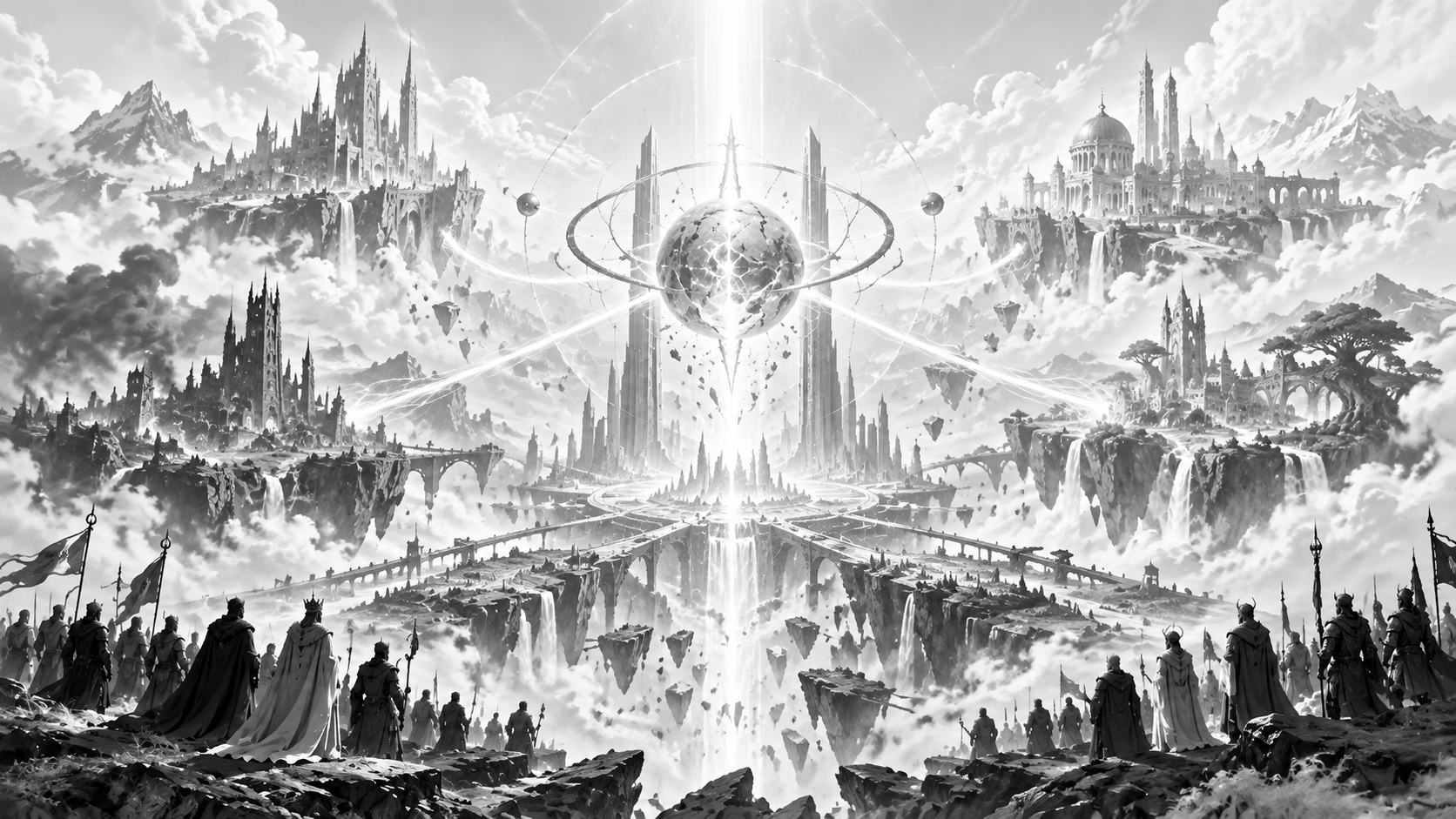
There was a time, long before Qorpra had a name, when the world was not divided by borders.
It was divided by layers.
The architects lived above the clouds, shaping what people could see.
The keepers of logic built their kingdoms beneath them, where rules, transactions, and decisions were forged.
Far below, the engineers of machines spoke in another tongue entirely. They commanded memory, processors, devices, networks, and metal.
And beneath even them were the smiths of silicon, working at the edge of matter itself.
Every kingdom believed its layer was the most important.
Every kingdom created its own language.
And eventually, every kingdom stopped understanding the others.
What began as specialization became separation.
What became separation became rivalry.
And rivalry became war.
The War of the Layers
The first battles were small.
The Kingdom of Interfaces accused the Kingdom of Systems of being too rigid.
Systems accused Interfaces of caring only for appearances.
The Cloud Lords claimed everything should belong to them.
The Machine Houses refused.
The Keepers of Data built walls around their knowledge.
The Device Clans created their own protocols.
The Silicon Foundries answered to no one.
Every faction created another abstraction, another framework, another bridge, another translator.
And every bridge required another bridge.
Soon, nobody remembered what the bridges were originally meant to connect.
Complexity grew until complexity itself became power.
Those who understood one kingdom could no longer speak to another.
Entire generations spent their lives translating intentions from one layer into the language of the next.
A simple idea might begin as a thought in the mind of a human and cross ten boundaries before a machine finally executed it.
At every boundary, something was lost.
Meaning.
Performance.
Security.
Time.
Sometimes even truth.
Then the Great Fracture began.
Systems that had been built to cooperate turned against one another.
Clouds disconnected from devices.
Devices refused their runtimes.
Runtimes rejected their applications.
Languages fractured into dialects.
Protocols multiplied.
Machines became faster while creation became slower.
The world possessed more computing power than ever before—
and less unity than it had ever known.
The war lasted so long that no kingdom remembered who had started it.
They only remembered that the ground had become dark.
And red.
Then the sky opened.
On the final night of the war, the armies gathered beneath a sky without stars.
The last remaining kingdoms prepared to destroy one another.
The chronicles say that when the first command was given to attack, there was no thunder.
No explosion.
No voice.
Only light.
A single beam descended from the heavens and struck the earth between the armies.
It did not burn the ground.
It illuminated it.
For the first time, every kingdom saw the same battlefield from the same light.
The warriors stopped.
The engineers looked toward the architects.
The architects looked toward the machine smiths.
The machine smiths looked toward the silicon foundries.
And they understood something that centuries of conflict had hidden from them:
They had never been separate worlds.
They were layers of the same world.
The light had no flag.
It belonged to no kingdom.
It demanded no throne.
It simply revealed the structure that had always existed beneath their divisions.
At the center of that light appeared a symbol.
A body.
A core.
A source.
They called it:
Qorpra.
Qorpra was not another kingdom.
That distinction became the foundation of everything that followed.
Qorpra did not arrive to conquer the layers.
It arrived to make conquest unnecessary.
It did not say:
One layer must rule the others.
It said:
Every layer is part of one system.
Qorpra became the name of a new idea:
Unity without uniformity.
Different layers could retain their purpose without becoming isolated.
Abstraction without blindness.
Higher levels could remain simple without pretending the machine beneath them did not exist.
Power without fragmentation.
A system could reach from the human interface to the physical machine without becoming a collection of disconnected technologies.
And above all:
Technology should follow human intent—not force human intent to follow technology.
This became known as the Qorpra Principle:
A system is not truly unified when its components merely connect.
It is unified when intention can travel through every layer without losing its meaning.
That principle ended the War of the Layers.
But it created a new problem.
The kingdoms now shared one direction.
They still did not share one language.
And so Qorpix was born.
The legend says that Qorpra possessed light, but light alone could not build.
The kingdoms needed a way to describe what should exist.
Not another language for another layer.
Not a language for interfaces.
Not a language for servers.
Not a language for machines.
Not a language for silicon.
They needed a language that could move with the light.
A language that would begin where human intention begins and descend as far as the machine required.
That language became:
Qorpix.
Qorpix was not created to become one more language in the war.
It was created because the war had taught one final lesson:
Every artificial boundary in the act of creation eventually becomes a tax on creation itself.
So Qorpix rejected the old doctrine that developers must constantly leave one world to enter another.
A different language for the interface.
Another for the backend.
Another for systems.
Another for devices.
Another for shaders.
Another for data.
Another for intelligence.
Another for the machine.
Why?
If the machine is one system, why should the thought that commands it be shattered into fragments?
Qorpix proposed something different.
Not that every layer is identical.
But that one language can understand the differences between them.
That distinction matters.
Unity is not sameness.
Qorpix does not erase layers.
It crosses them.
The philosophy of Qorpra
From that mythology comes a philosophy.
We call it Computational Unity.
Its first principle is simple:
There should be no unnecessary distance between intention and execution.
A programmer should be able to begin with an idea at the highest level of abstraction and, when necessary, descend all the way to the metal without abandoning the intellectual universe in which that idea was born.
The second principle is:
Abstraction must be permeable.
An abstraction that cannot be crossed becomes a prison.
High-level development should make simple things simple.
But low-level power should never require escaping the language entirely.
The third principle:
Performance is not the enemy of expressiveness.
For too long, software development has accepted a false choice.
Either write expressive software and pay for abstraction—
or write fast software and sacrifice clarity.
Qorpra rejects that bargain.
The machine should become better at understanding human intent, not force humans to think increasingly like machines.
The fourth principle:
Complexity belongs inside the system, not inside the mind of the creator.
Compilers, runtimes, build systems, tooling and infrastructure exist to absorb complexity.
Not to export it back to developers.
And the fifth:
A technology that cannot evolve will eventually become another kingdom in another war.
Qorpra therefore treats extensibility not as an accessory, but as part of the foundation.
New domains should not require a new universe.
The universe itself should be able to grow.
One Core. Every Direction.
The name Qorpra carries this philosophy.
Qorp evokes the core, the corpus, the organized whole.
It is the body rather than one of its limbs.
And Ra evokes light.
Energy.
The source by which direction becomes visible.
Not a ruler sitting above the system—
but the light by which the system can see itself.
There is another interpretation hidden in the name.
Corp + Ra.
The organized body and the ancient symbol of solar power.
Almost, playfully, the god of corporations.
But Qorpra's mythology deliberately rejects the idea of domination.
Its power is not the power to command every layer.
Its power is the ability to connect them without destroying their individuality.
That is why its central phrase is not:
One core to rule them all.
It is:
One core. Every direction.
Qorpix is the language of that light.
The name shares the same root because Qorpix does not exist beside Qorpra.
It exists inside its philosophy.
Qorpra is the world.
Qorpix is how that world speaks.
A Qorpix program should be able to begin as something human:
an interface,
an idea,
an rule,
an agent,
a simulation,
a service—
and travel downward.
Through libraries.
Through runtimes.
Through operating systems.
Through devices.
Through machine instructions.
Until eventually intention becomes electricity moving through silicon.
No ritual of changing languages simply because a conceptual border has been crossed.
No assumption that high level and low level must exist in different intellectual worlds.
That is the ambition behind:
One language. Every layer.
Not “one language because every problem is the same.”
The opposite.
One language because every layer is different, yet still belongs to the same system.
From UI to silicon.
This is where myth becomes engineering.
The beam of light in the story is not magic.
It is intent.
The kingdoms are not imaginary.
We know them today as frontend, backend, cloud, mobile, embedded, AI, systems programming, operating systems, databases, GPUs and hardware.
The translators between those kingdoms are real too.
Frameworks.
FFIs.
Build chains.
Serialization boundaries.
Language bridges.
Runtime boundaries.
Tooling silos.
Entire industries have been built around helping one computational kingdom speak to another.
Qorpra asks a dangerous question:
What if many of those borders were never fundamental?
What if some existed only because our tools inherited the limitations of the systems that came before them?
And what if we designed a new computational world without accepting those borders as laws of nature?
That is the question behind Qorpra.
Qorpix is our attempt to answer it.
The war is not over.
Not literally.
There are no armies waiting beneath a dark sky.
But fragmentation is still everywhere.
Developers still rewrite the same intent in different languages.
Companies still duplicate systems because platforms cannot share abstractions.
Performance is still traded against productivity.
Safety against control.
Portability against native capability.
High level against low level.
Human readability against machine efficiency.
We have learned to call these trade-offs inevitable.
Qorpra begins by refusing that assumption.
Perhaps some compromises truly are fundamental.
But they must be proven fundamental, not inherited unquestioned.
That distinction is the beginning of the ideology.
The Qorpra Doctrine
If it must be reduced to a few principles, let them be these:
Technology is one continuum.
Human intent is the origin.
The machine is the destination, not the master.
Abstractions should empower without imprisoning.
Performance should emerge from intelligence in the system, not suffering in the developer.
Different layers deserve different semantics—not different universes.
Extensibility is freedom from technological stagnation.
And complexity should be conquered by architecture, not transferred to people.
That is Qorpra.
And Qorpix is the language built to make that philosophy executable.
The old kingdoms believed the future belonged to whichever layer became powerful enough to dominate the others.
They were wrong.
The future belongs to the system capable of seeing them all as parts of the same whole.
And according to the legend, when the battlefield finally fell silent, the light remained.
Not above them.
Not beneath them.
But passing through every layer.
They called the light Qorpra.
And when humanity finally learned how to speak through it—
they called the language Qorpix.
Qorpra — One core. Every direction.
Qorpix — One language. Every layer.
From UI to silicon.